I have been a fan of professional wrestling for most of my life. Here's a little bit of that history to set the scene. Much like wrestling, there may be a little embellishment, and my memory is not to be trusted.
I was a child of the late 80s, early 90s. My family would borrow VHS tapes of American wrestling from my Grandad that he had religiously recorded from the TV every week. It would have been the WWF at the time, the era of Hulk Hogan, Macho Man Randy Savage, and Bret Hart. My Dad would only watch the matches, and fast-forward through any talking, not interested in the storylines.
In the late 90s, as a teenager, I was watching the wrestling alone or with friends, which meant that I finally got to see and hear the shows in their entirety. This was the Attitude Era, with wrestlers like The Rock and Mick Foley who were as good on the microphone as they were in the ring. I heard about a rival promotion, WCW. Some of my friends felt it was superior, referencing high-flyers like Rey Mysterio Jr. I wasn't convinced enough to try it having watched WWF for years by this point. It was comfortable.
Those familiar with professional wrestling history will know that there was a bitter rivalry between WWF and WCW at that time. Wrestlers would defect between the companies, looking for bigger paycheques or better positions on the card. I was still young, and I would have had an attitude that WWF was the best promotion, so if a wrestler didn't work there, they probably weren't very good. But then, wrestlers like Hulk Hogan, Macho Man Randy Savage, and Bret Hart moved over to WCW. I guess that should have started to open my eyes. It might have been when The Radicalz joined WWF (Eddie Guerrero, Chris Benoit, Dean Malenko, and Perry Saturn) that I started to realise the quality of talent that must exist elsewhere.
WCW lost the war, and was sold to WWF in 2001. WWF rebranded as WWE in 2002. My viewing started to taper off around this time. I was getting older and my interests were changing, though I would still catch the occasional show. Without the competition, I felt that WWE was starting to go stale.
I don't recall how I heard of it, maybe through a friend, maybe an internet post, but a few years later I became aware of TNA and gave it a go. The size of crowds made it obvious they weren't at the level of WWE, but there was something different here. WWE notoriously had a type: large muscular men, wrestling a relatively methodical, safe style. There were exceptions, but that was the standard. TNA, in contrast, had variety. Smaller guys like Amazing Red and Petey Williams were doing incredible work. Women like ODB and Awesome Kong certainly didn't fit the WWE Diva mould, but were entertaining fan favourites. Then there were future stars like AJ Styles, Christopher Daniels, and Samoa Joe, putting on 5-star matches. Phenomenal.
TNA helped me to shake some, but not all, of my wrestling naivety. Wrestling existed outside of the WWE, and it was good. The underdog trope isn't unique to wrestling, and it is certainly used in matches and storylines, but this was the first time I was rooting for an underdog promotion.
In 2009, Hulk Hogan signed with TNA. At the time, I was optimistic, thinking it would bring attention and investment to push the company enough to compete with WWE, reigniting the Monday Night Wars that I was oblivious to the first time around. I did say that I hadn't lost all of my wrestling naivety. Hulk Hogan was a huge name, but was 56 years old at the time. He brought along his buddies, who were also past their prime. The focus of the shows changed, and TNA's originals fell out of favour. TNA lost what had made it different, and again, my interest waned.
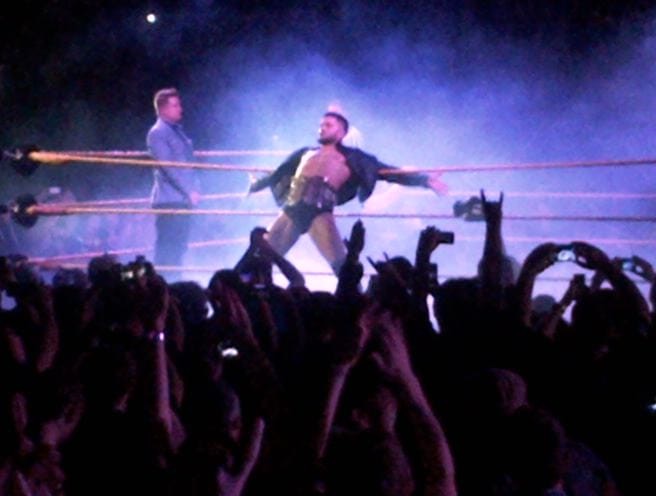
The entirety of my wrestling fandom, to this point, had been through a TV screen. In 2015, there was an NXT TakeOver UK Tour, and a show was being held locally. My girlfriend booked tickets, and we went along with a couple of our friends. I was aware of NXT, perhaps reading about it on SquaredCircle, but I don't believe I had watched much at the time. Not the best seats, but the show was awesome. The crowd were hot, the chants were creative, and the matches were solid. We saw people who would turn out to be stars, even if we didn't realise it at the time. Asuka, Sami Zayn, Finn Balor, to name a few. And yet, I didn't attend another live wrestling event for almost a decade.
In 2018, All In happened. Not yet AEW, but the beginning of what felt like a wrestling revolution that took me on The Long Road to All In: London.